
A published qualitative study I led on how Gen Alpha and Gen Z relate to AI, and what it means for digital products.
Client
University of Messina
Industry
Research & Academia
Year
2025
Methodology
Qualitative research
Role
Lead UX Researcher
Team
Chief Experience Officer Lead UX Researcher Research Fellow Associate Professor
Activities
Research design Semi-structured interviews Data analysis Report writing
Deliverables
Research report Academic paper contribution
A published qualitative study I led on how Gen Alpha and Gen Z relate to AI, and what it means for digital products.
Client
University of Messina
Industry
Research & Academia
Year
2025
Methodology
Qualitative research
Role
Lead UX Researcher
Team
Chief Experience Officer Lead UX Researcher Research Fellow Associate Professor
Activities
Research design Semi-structured interviews Data analysis Report writing
Deliverables
Research report Academic paper contribution
A published qualitative study I led on how Gen Alpha and Gen Z relate to AI, and what it means for digital products
Client
University of Messina
Industry
Research & Academia
Year
2025
Methodology
Qualitative research
Role
Lead UX Researcher
Team
Chief Experience Officer Lead UX Researcher Research Fellow Associate Professor
Activities
Research design Semi-structured interviews Data analysis Report writing
Deliverables
Research report Academic paper contribution
RESEARCH QUESTION
Designing for a generation we're mostly guessing about
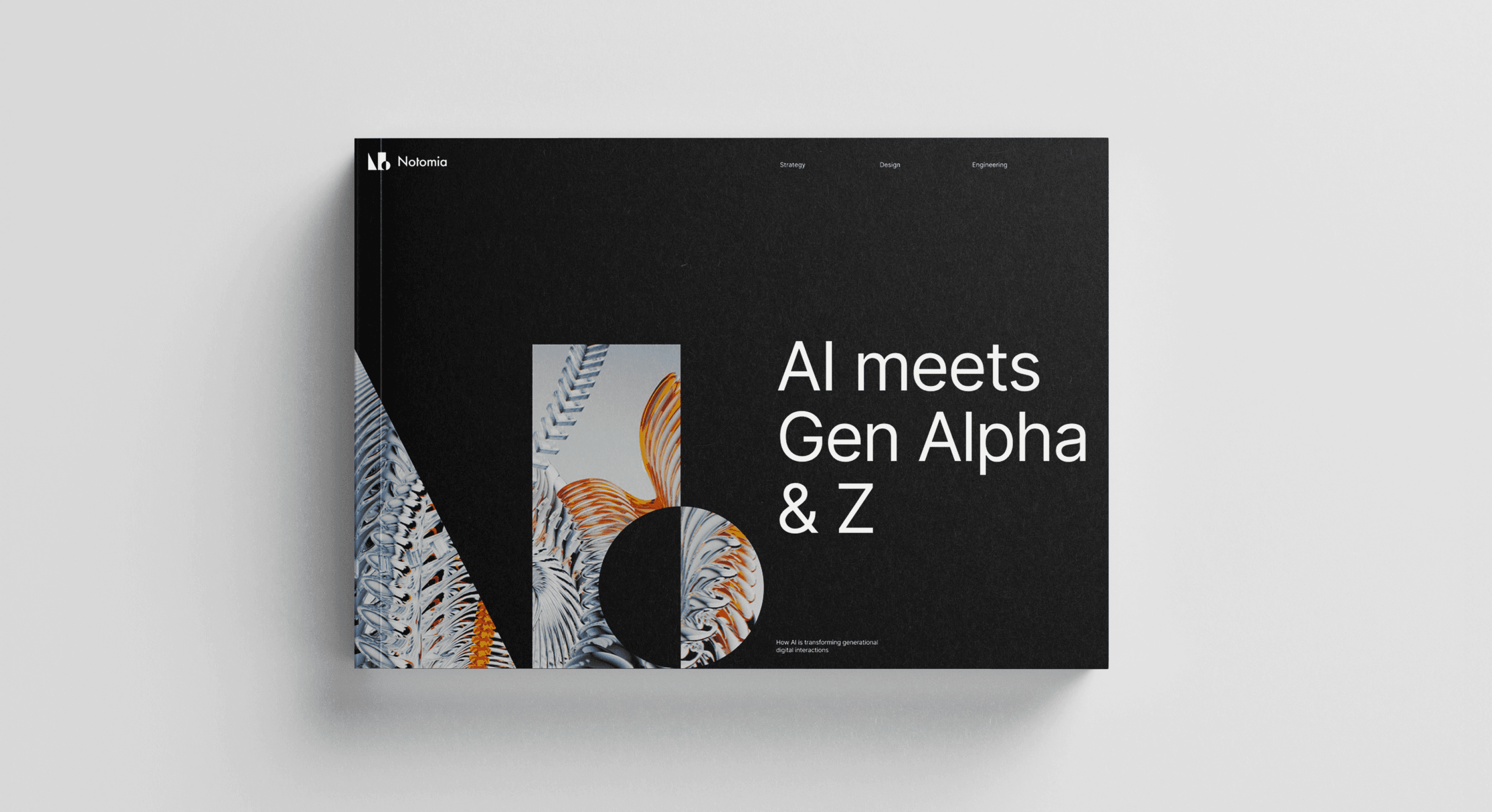
Gen Alpha and Gen Z are the first generations growing up with AI as a normal part of daily life, but how they actually relate to it is barely understood. Most assumptions about young people and technology are made by people who didn't grow up the same way. For anyone designing future products, that gap matters: you can't design well for a generation you're guessing about. The study set out to replace assumption with evidence, asking how these generations really perceive, trust and use AI.
RESEARCH QUESTION
Designing for a generation we're mostly guessing about
Gen Alpha and Gen Z are the first generations growing up with AI as a normal part of daily life, but how they actually relate to it is barely understood. Most assumptions about young people and technology are made by people who didn't grow up the same way. For anyone designing future products, that gap matters: you can't design well for a generation you're guessing about. The study set out to replace assumption with evidence, asking how these generations really perceive, trust and use AI.
RESEARCH QUESTION
Designing for a generation we're mostly guessing about
Gen Alpha and Gen Z are the first generations growing up with AI as a normal part of daily life, but how they actually relate to it is barely understood. Most assumptions about young people and technology are made by people who didn't grow up the same way. For anyone designing future products, that gap matters: you can't design well for a generation you're guessing about. The study set out to replace assumption with evidence, asking how these generations really perceive, trust and use AI.

METHOD
How the study was run
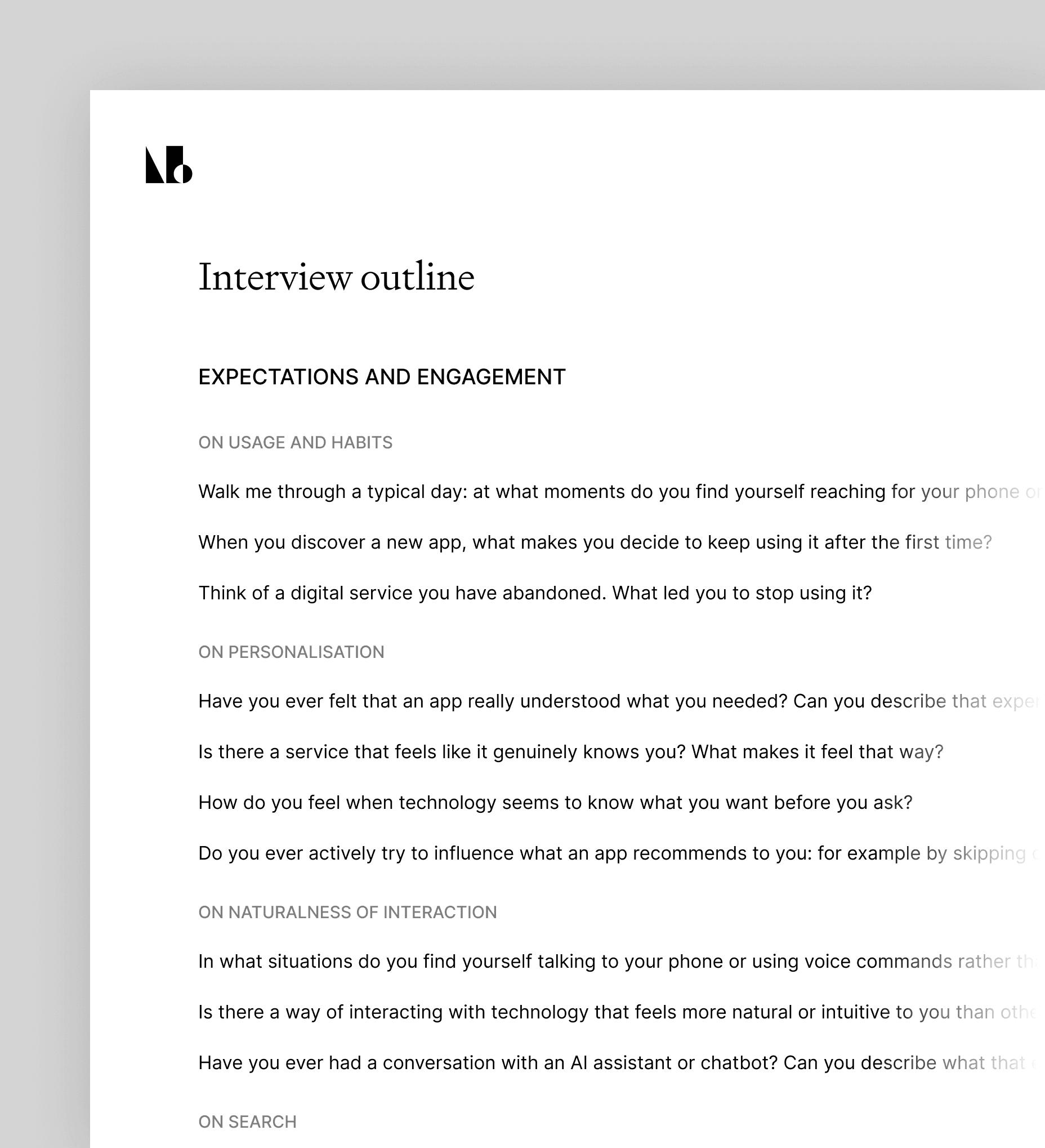
I led the study end to end, from protocol and interview design through to synthesis and the final write-up. It ran on 25 semi-structured interviews with participants aged 12 to 25, recruited through snowball sampling across several separate networks to spread the sample across different regions rather than one social circle. The sample was deliberately gender-balanced and spread evenly across the age range. The interviews covered four themes: expectations and engagement, emotional perception and trust, accessibility and inclusivity, and future perspectives.
METHOD
How the study was run
I led the study end to end, from protocol and interview design through to synthesis and the final write-up. It ran on 25 semi-structured interviews with participants aged 12 to 25, recruited through snowball sampling across several separate networks to spread the sample across different regions rather than one social circle. The sample was deliberately gender-balanced and spread evenly across the age range. The interviews covered four themes: expectations and engagement, emotional perception and trust, accessibility and inclusivity, and future perspectives.
METHOD
How the study was run
I led the study end to end, from protocol and interview design through to synthesis and the final write-up. It ran on 25 semi-structured interviews with participants aged 12 to 25, recruited through snowball sampling across several separate networks to spread the sample across different regions rather than one social circle. The sample was deliberately gender-balanced and spread evenly across the age range. The interviews covered four themes: expectations and engagement, emotional perception and trust, accessibility and inclusivity, and future perspectives.

FINDINGS
How two generations relate to AI
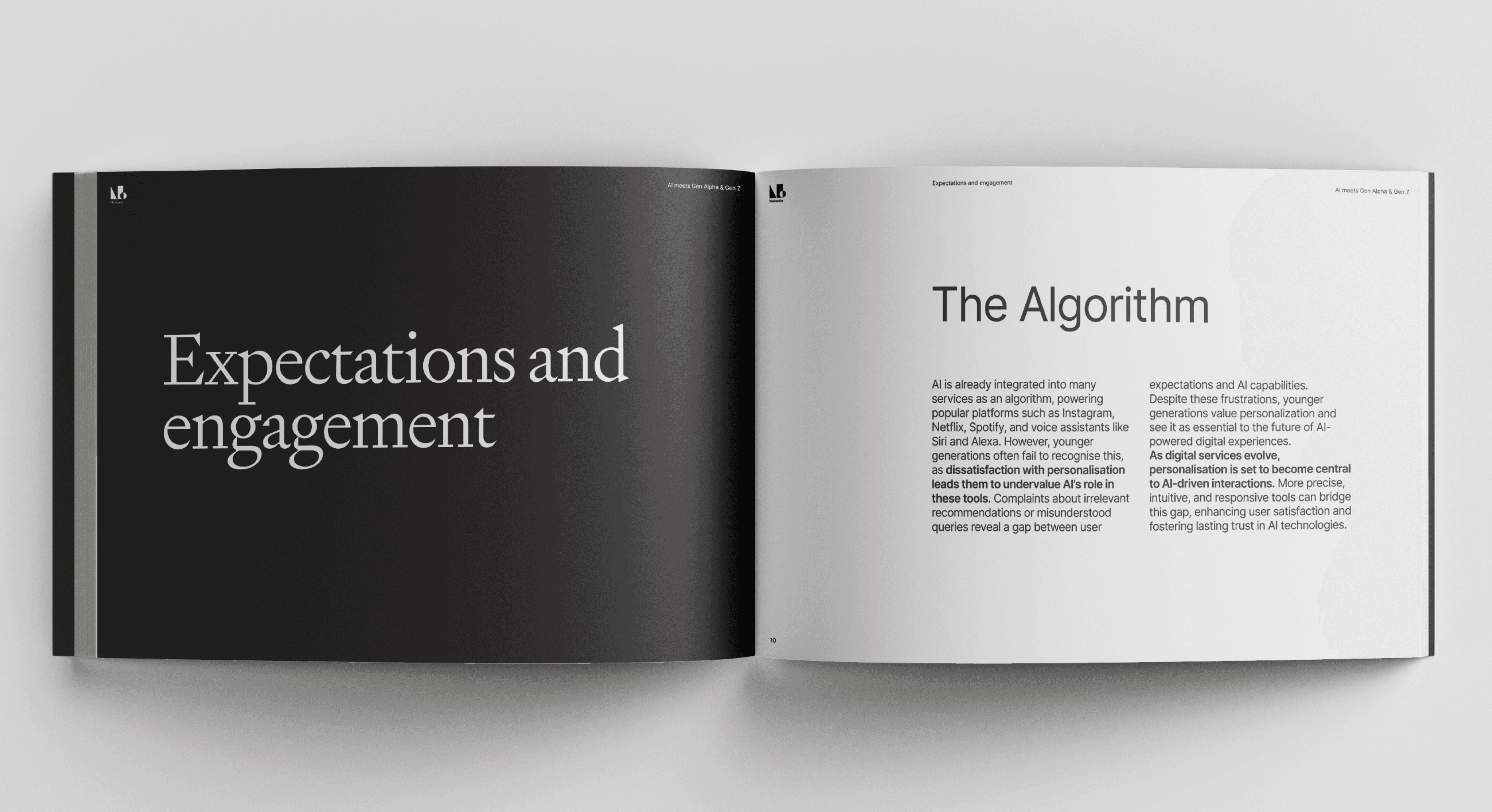
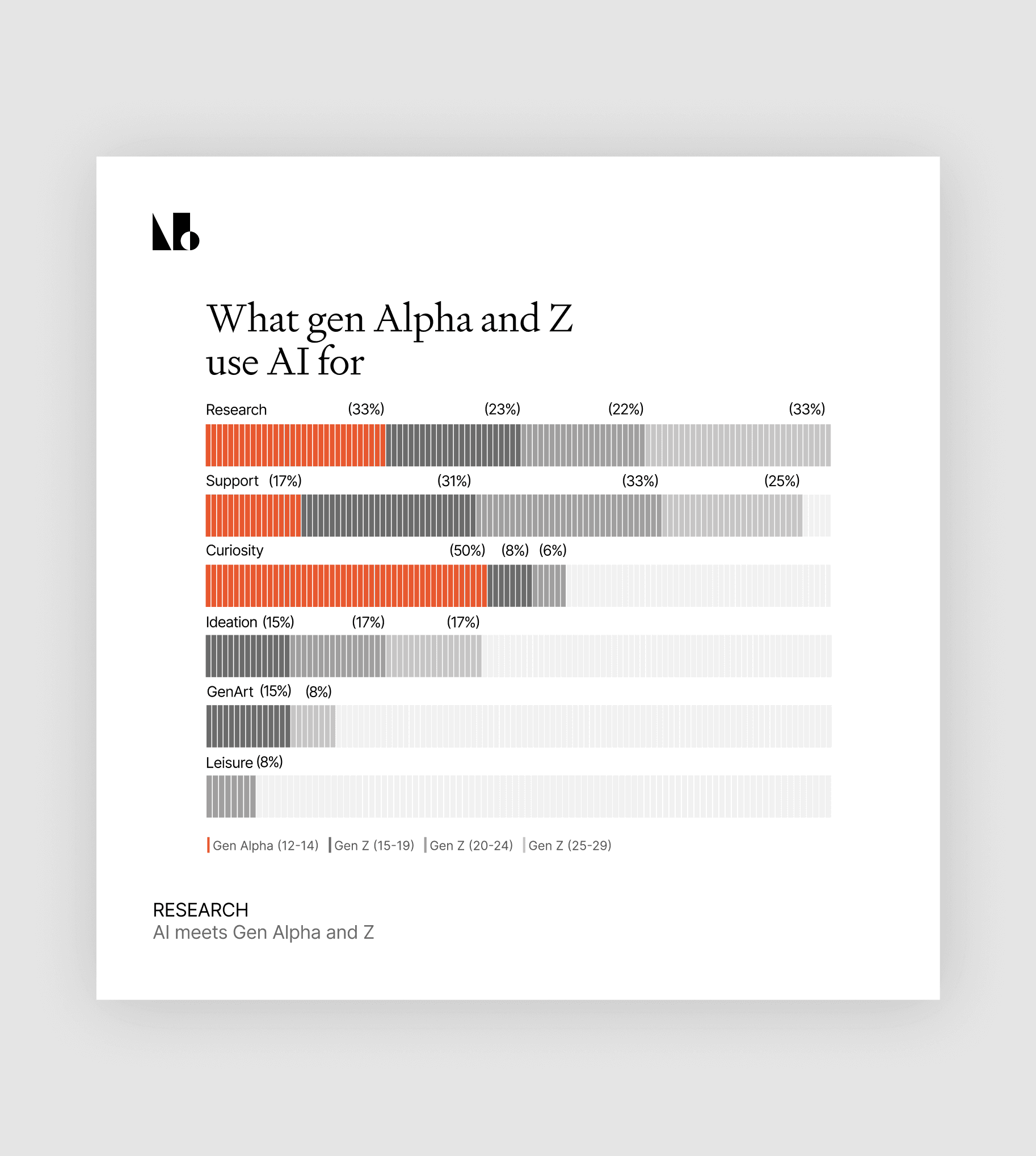
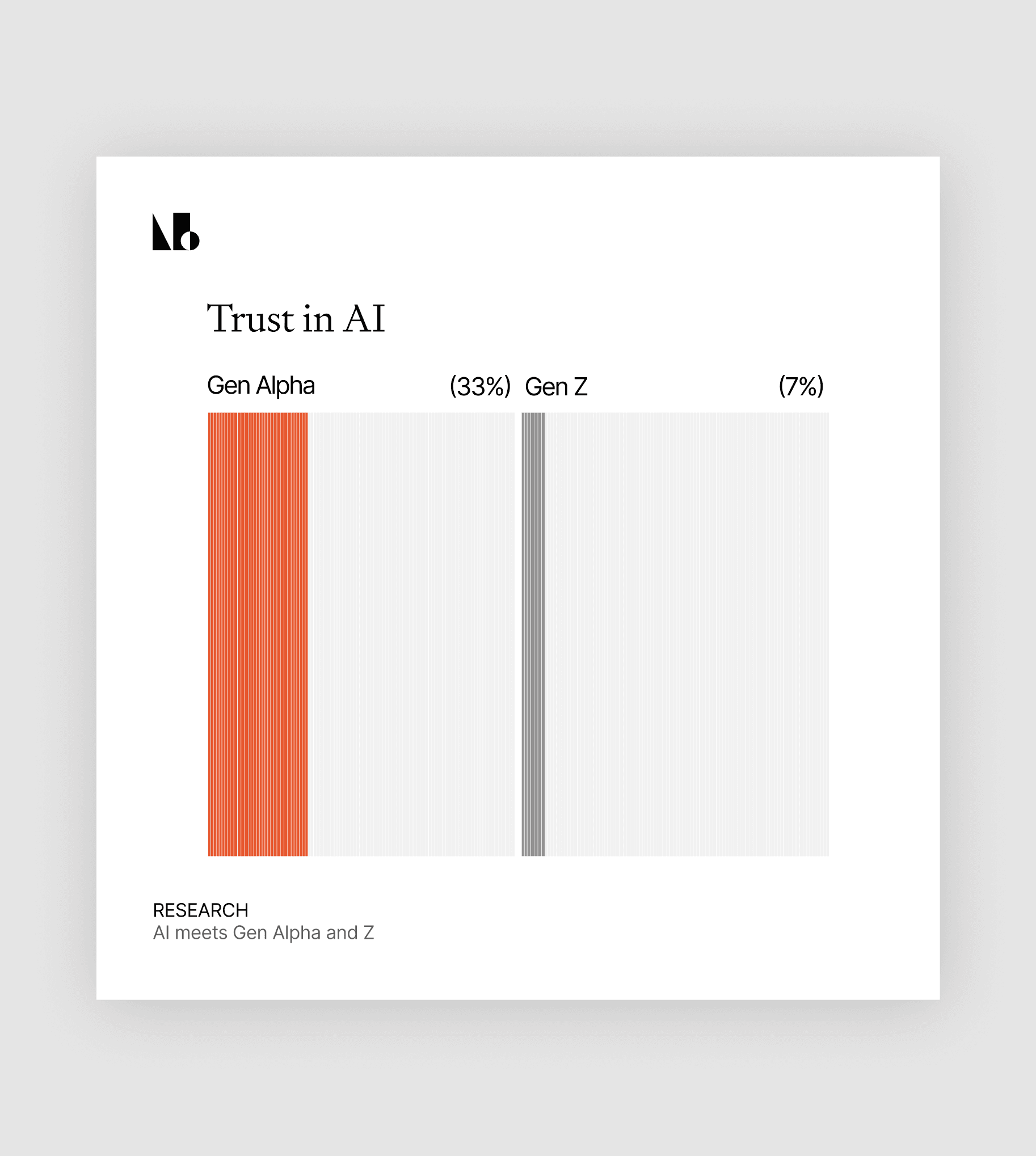
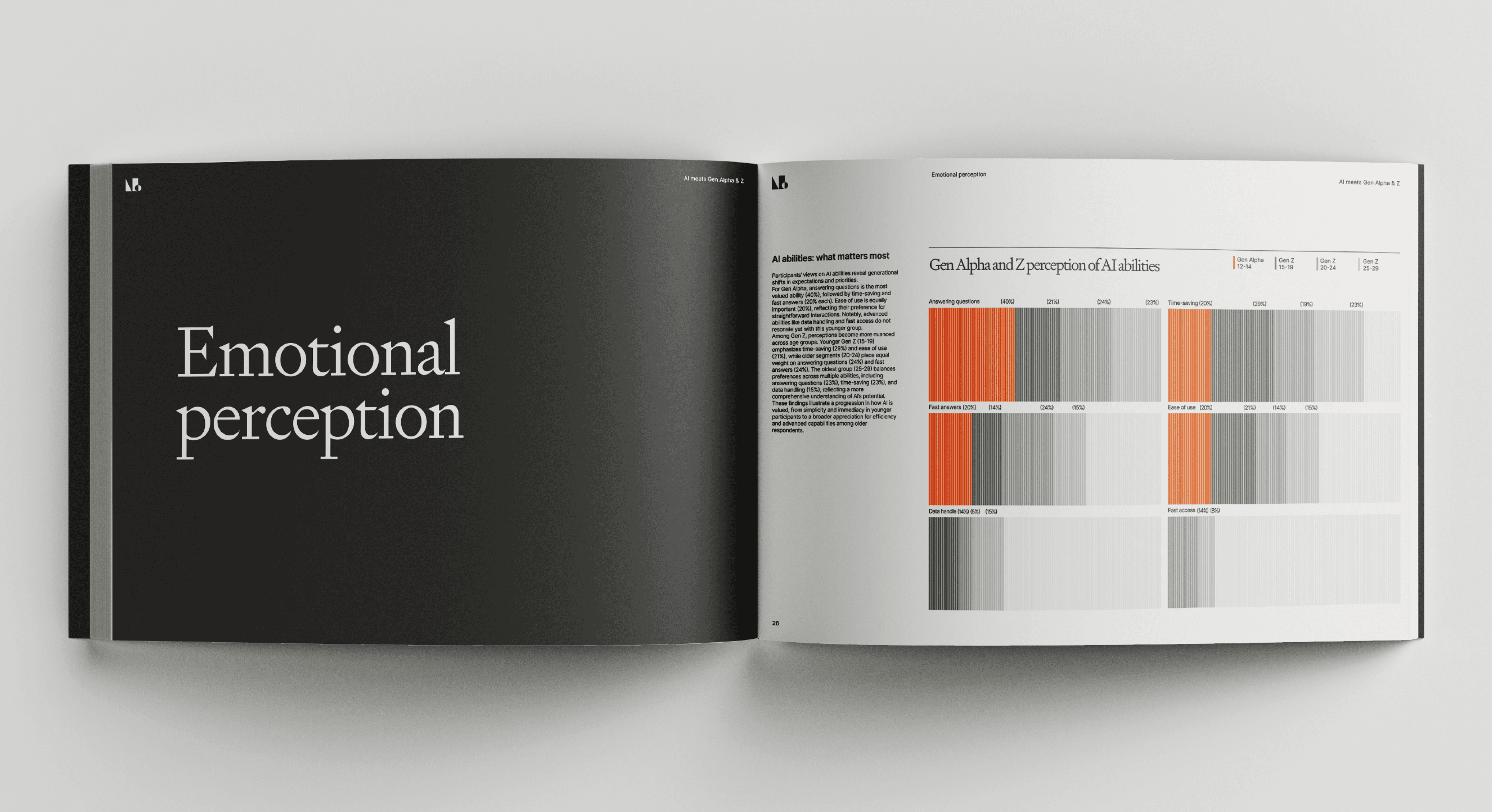
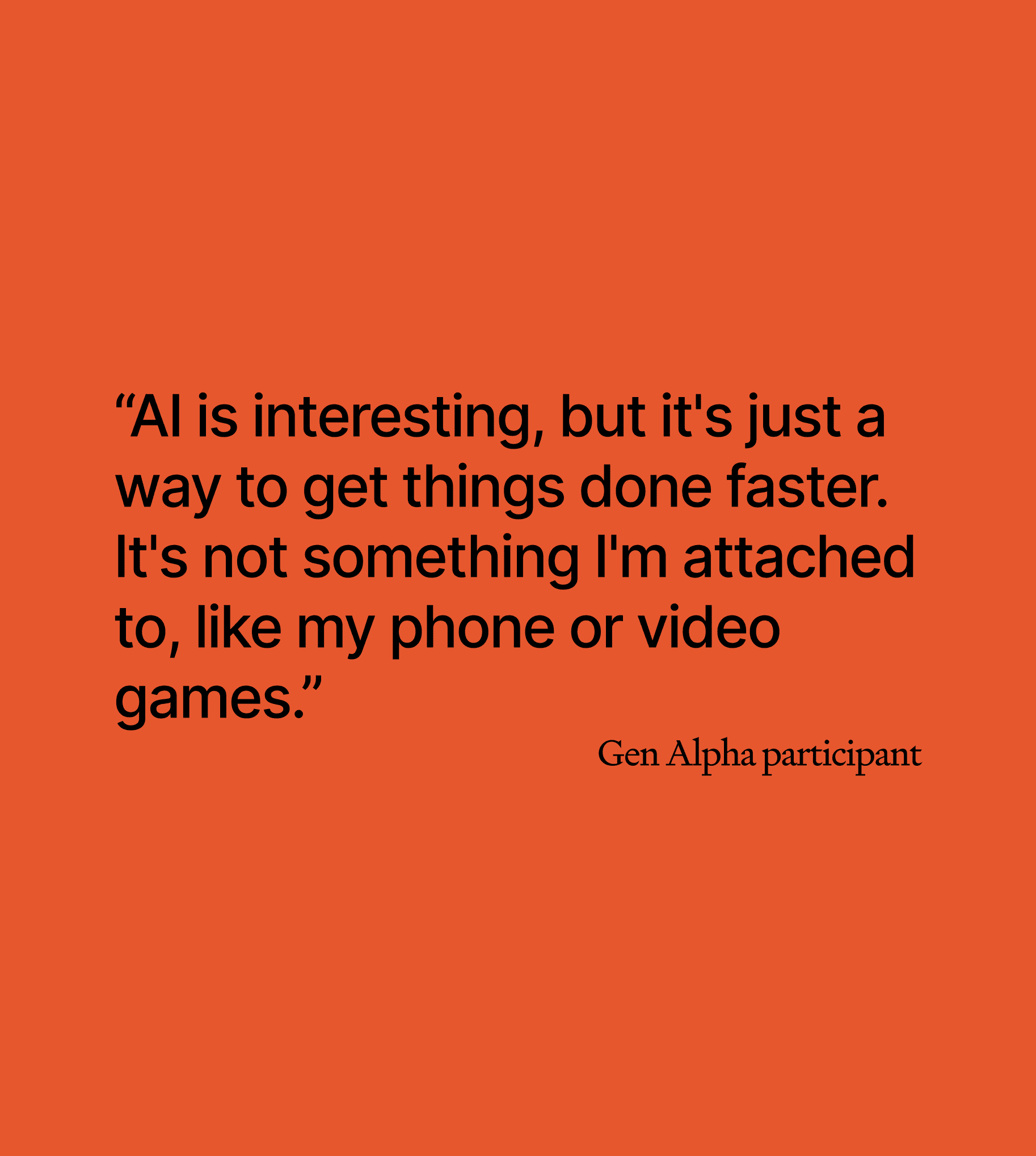
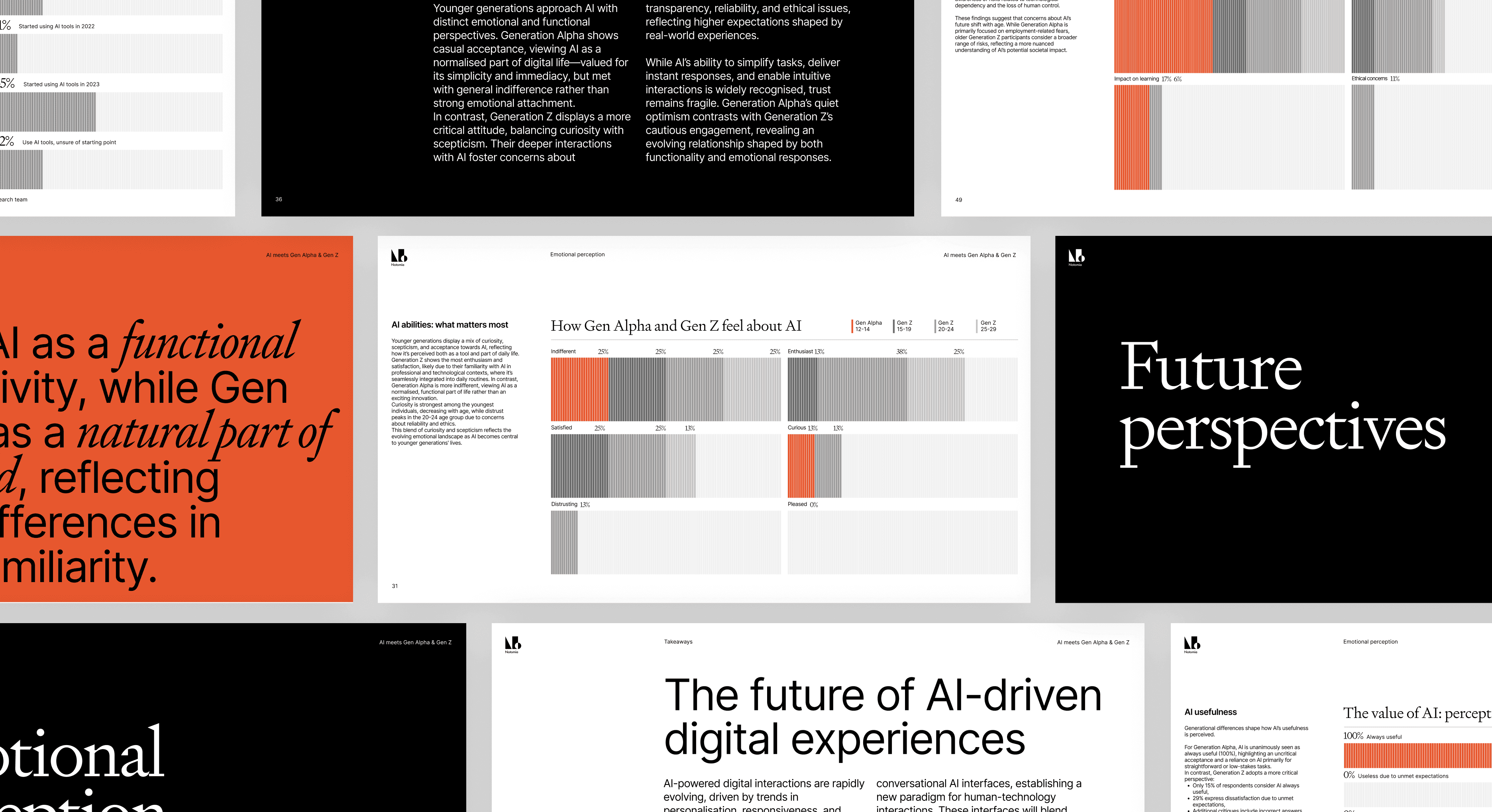
The clearest finding was a trust gap that runs opposite to what you'd expect: the generation using AI most trusts it least. Only 7% of Gen Z said they trust AI, against 33% of Gen Alpha, even though Gen Z relies on it daily and Gen Alpha uses it more casually. The two generations relate to AI in fundamentally different ways. Gen Alpha engages with it naturally, with little friction and little emotional attachment, it's simply part of how things work. Gen Z uses it constantly but keeps it at arm's length, questioning its transparency and how its answers are produced. What they share is a gap between how much they use AI and how much they expect from it: across both groups, expectations were high and satisfaction was not. They want AI that anticipates their needs and feels genuinely personal, and they don't think today's products deliver it.
FINDINGS
How two generations relate to AI
The clearest finding was a trust gap that runs opposite to what you'd expect: the generation using AI most trusts it least. Only 7% of Gen Z said they trust AI, against 33% of Gen Alpha, even though Gen Z relies on it daily and Gen Alpha uses it more casually. The two generations relate to AI in fundamentally different ways. Gen Alpha engages with it naturally, with little friction and little emotional attachment, it's simply part of how things work. Gen Z uses it constantly but keeps it at arm's length, questioning its transparency and how its answers are produced. What they share is a gap between how much they use AI and how much they expect from it: across both groups, expectations were high and satisfaction was not. They want AI that anticipates their needs and feels genuinely personal, and they don't think today's products deliver it.
FINDINGS
How two generations relate to AI
The clearest finding was a trust gap that runs opposite to what you'd expect: the generation using AI most trusts it least. Only 7% of Gen Z said they trust AI, against 33% of Gen Alpha, even though Gen Z relies on it daily and Gen Alpha uses it more casually. The two generations relate to AI in fundamentally different ways. Gen Alpha engages with it naturally, with little friction and little emotional attachment, it's simply part of how things work. Gen Z uses it constantly but keeps it at arm's length, questioning its transparency and how its answers are produced. What they share is a gap between how much they use AI and how much they expect from it: across both groups, expectations were high and satisfaction was not. They want AI that anticipates their needs and feels genuinely personal, and they don't think today's products deliver it.

IMPACT
Evidence to design with
The study was published as an academic paper and book in collaboration with the University of Messina. For me it's less an academic exercise than a working reference: it shapes how I approach designing AI products for younger users, with evidence rather than assumption. The trust gap in particular is a useful design signal, the generation most fluent in AI is also the most skeptical of it, which changes how you earn their confidence in a product. Work like this grounds my approach to AI design in how people actually relate to the technology, which is where I think good AI products start.
IMPACT
Evidence to design with
The study was published as an academic paper and book in collaboration with the University of Messina. For me it's less an academic exercise than a working reference: it shapes how I approach designing AI products for younger users, with evidence rather than assumption. The trust gap in particular is a useful design signal, the generation most fluent in AI is also the most skeptical of it, which changes how you earn their confidence in a product. Work like this grounds my approach to AI design in how people actually relate to the technology, which is where I think good AI products start.
IMPACT
Evidence to design with
The study was published as an academic paper and book in collaboration with the University of Messina. For me it's less an academic exercise than a working reference: it shapes how I approach designing AI products for younger users, with evidence rather than assumption. The trust gap in particular is a useful design signal, the generation most fluent in AI is also the most skeptical of it, which changes how you earn their confidence in a product. Work like this grounds my approach to AI design in how people actually relate to the technology, which is where I think good AI products start.
Next up
Next up
Next up